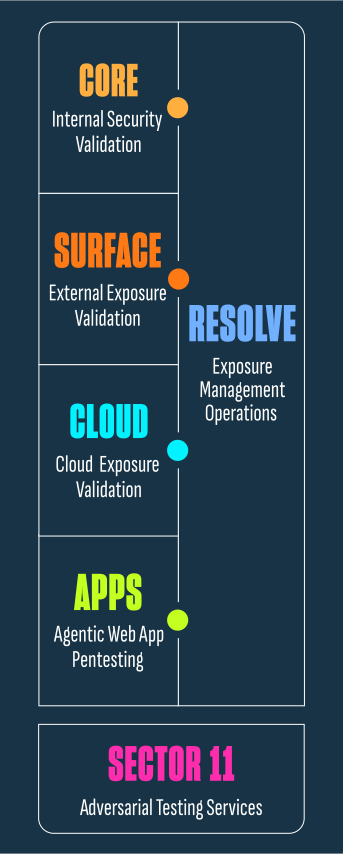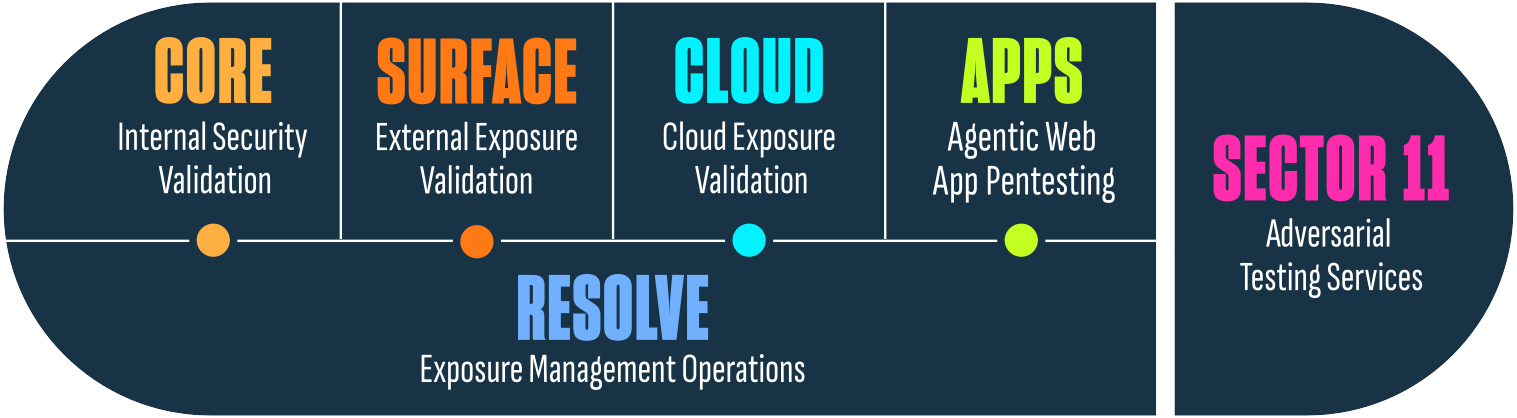

Validate exploitable risk across internal networks, external assets, cloud, web applications and APIs on one platform. Prioritize remediation based on proven attack paths, then revalidate fixes to confirm the exposure is closed.
Pentera supports all five stages of Continuous Threat Exposure Management (CTEM) with security validation at the core. Manage the full exposure lifecycle by identifying what is truly exploitable, prioritizing your most critical exposures, mobilizing remediation through automated workflows, and confirming measurable risk reduction over time.
How customers are using Pentera.
Run continuous, production-safe penetration tests that emulate real-world adversaries across your environment. Ensure that changes across infrastructure and security controls don’t create new exploitable paths, prioritize remediation based on proven exploitability, and eliminate risk on-demand.
Run agentic pentests across web applications, APIs and business logic. Validate authenticated workflows and access controls, give developers reproducible exploit evidence, and revalidate fixes as applications change.
Continuously test how far an attacker could progress in your production environment. Measure their reach, identify where security controls prevent escalation, and validate resilience under realistic adversary conditions. Augment your automated testing with expert services from Pentera’s Sector11 team.
Proactively test whether ransomware could spread across your environment, reach high-impact assets, and successfully encrypt critical systems and data. Validate exposure against real-world families such as LockBit, BlackCat (ALPHV), Play, Cl0p, REvil, Conti, and Maze. Identify security gaps that enable lateral movement and privilege escalation, strengthen controls that block attacker progression, and validate that exposure has been effectively eliminated.
Turn threat intelligence into immediate risk reduction. Validate whether leaked credentials from the dark web and paste sites create real initial access. Prioritize exposed accounts, and eliminate credential-based attacks before attackers can exploit them.
Test whether cracking techniques could compromise domain credentials. Identify weak, reused, and easily guessable credentials that attackers could compromise. Prioritize high-risk accounts and remediate password exposure before it enables lateral movement or privilege escalation.
Move beyond CVSS severity scores and focus on what attackers can actually exploit. Identify which vulnerabilities can be used in real-world attacks, address the root causes that enable escalation, and remediate the exposures that reduce risk.
Validate which internet-facing assets provide initial access into your environment. Safely emulate attacker techniques to determine what can actually be exploited, how external exposures translate into internal compromise, and which weaknesses create meaningful business risk.
Test your detection and response under real attack conditions. Emulate real-world adversary techniques using authentic indicators of compromise (IoCs) to validate how your security controls and SOC respond to realistic attack activity. Optimize your technology and processes to ensure response readiness.
Operationalize Continuous Threat Exposure Management (CTEM) by continuously validating against real attacks. Confirm which exposures are truly exploitable, prioritize what reduces attacker reach, mobilize remediation with native integrations, and validate that fixes reduce risk.
Pentera validates exploitable attack paths across internal networks, internet-facing assets, cloud, web applications and APIs. It tests whether attackers can bypass controls, abuse access or business logic, and reach critical assets. Teams use validated evidence to prioritize remediation and revalidate fixes.
Breach and Attack Simulation focuses on executing predefined techniques or scenarios in simulated environments. Pentera executes complete attacks in live production to prove whether attackers can actually progress attacks across the environment and reach critical assets.
Yes. Pentera is designed for safe testing in live production environments. Customer-defined scope, execution controls and safeguards govern testing. For Pentera Apps, a purpose-built execution harness enforces testing policies and controls which actions AI agents execute against applications.
Pentera includes autonomous penetration testing, but it operates differently from traditional pentests. Instead of a periodic, manual engagement that produces a static report, Pentera continuously executes autonomous testing at scale in production and revalidates fixes to ensure exposure is actually reduced over time.
Continuous Threat Exposure Management (CTEM) is a program framework, not a platform. Pentera supports every phase of the CTEM lifecycle by providing continuous adversarial validation that proves which exposures are exploitable and whether remediation reduces real exploitability.